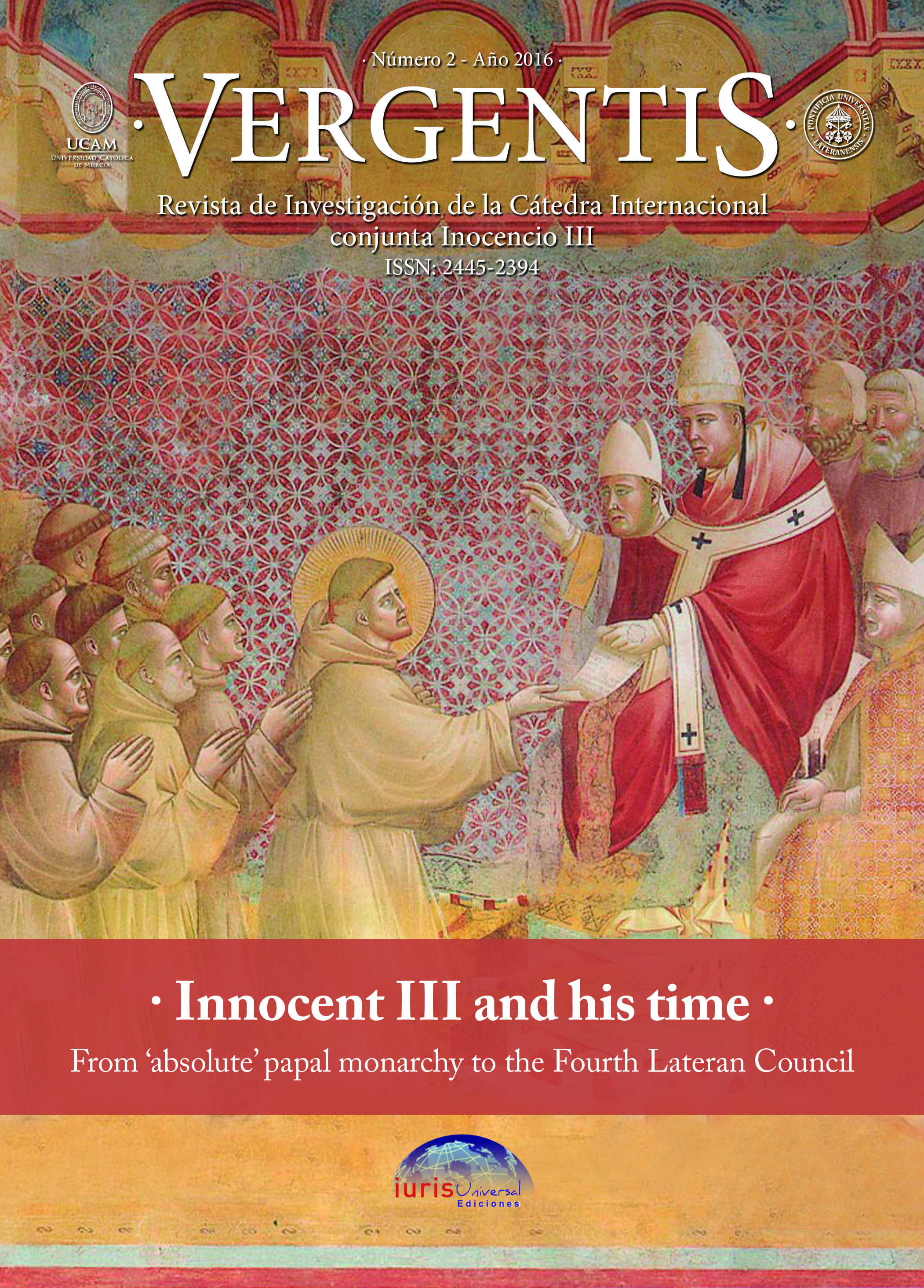
Inocencio III entre derecho y sociedad: costumbres, escándalos y el consentimiento popular
Palabras clave:
Innocent III, scandal, custom, society, consentResumen
According to medieval canon law, legal rules could be waived, thus avoiding any scandals and therefore preventing a motive for public discord. As regards the custom, this principle was shaped according to the religious and political contingencies, in order to recognize or deny any effects to customary rules. Different solutions were adopted with a view to maintaining social support towards the institutions: it was necessary to take into account both the popular spirit expressed abiding by the customs and the reactions of public opinion to the application or non-application of them. Innocent III helped to figure out the legal relevance of scandals, through the principle that it was essential to avoid at all costs dissents or oppositions in the Christian community: sometimes he uprooted the customs contrary to that of the Roman Church, which were considered dangerous to the unity of faith; other times he secured the application of the rites to which the population showed the greatest attachment. The policy of Innocent III urged, on this point, the remarks of the canonical doctrine: his decretals and the fourth Lateran council constitutions were utilized in the period of the great schism, in order to balance out the need both to maintain the unity within the Church and to respect the different ceremonial practices.
Keywords: Innocent III, scandal, custom, society, consent.
Descargas